

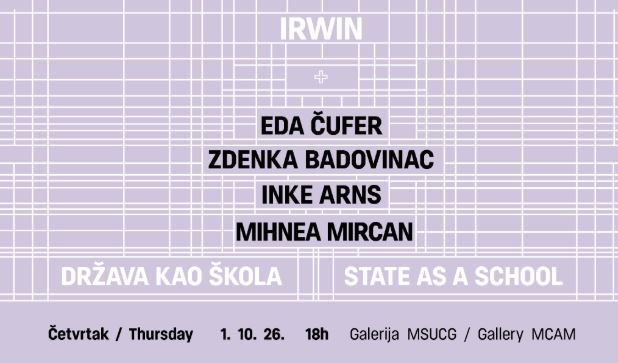
IRWIN + Eda Čufer, Zdenka Badovinac, Inke Arns, and Mihnea Mircan
📍 MSUCG Gallery | October 1st, 2026, from 6:00 PM
The Museum of Contemporary Art of Montenegro (MSUCG) is delighted to announce The State as a School, an exhibition presenting the Slovenian collective IRWIN in dialogue with their long-term collaborators Eda Čufer, Zdenka Badovinac, Inke Arns, and Mihnea Mircan.
The exhibition is conceived as a discursive space that re-examines the production of knowledge and historical memory outside the dominant narratives established after 1989. Moving backward toward the collective’s formative site and its core ideas—the dissolution of Yugoslavia and post-Cold War cartography—it rejects teleological interpretations of transition.
Every school participant will receive a copy of The State as a School notebook, which features an introductory text by the exhibition’s curator, Natalija Vujošević, and the essay “Post-Socialism” by Tomaž Mastnak, courtesy of L’Internationale (Post-Socialism). Vujošević proposes Mastnak’s text as a navigational tool for traversing the historical, political, economic, and ideological coordinates surrounding the formation of the NSK State in Time, from the pivotal year of 1989 to the present day, tracing the transformations that shaped the post-Yugoslav space and the conditions from which we look, think, and act today.
Alongside a series of discussions and lectures, the exhibition showcases ready-made photographic series, documented performances, and video works, while a segment of the project extends into the public space. The selected works occupy multiple positions: as part of an oeuvre, as an active archive, and as a methodological framework. The gallery transforms into the territory of the NSK State in Time, an embassy, a school, and a site for generating critical reflection and political imagination.
The body of the exhibition takes shape throughout its duration, utilizing a backward motion to critically rethink the relationships between art, politics, and history, thereby articulating a new perspective on the present. The exhibition space functions as a place of negotiation, research, and orientation, where shifted viewpoints and complex geopolitical choreographies are considered—leaving a permanently open question: is it time for a new state?
🎁 The Museum is giving away NSK passports to the first five school participants!
🗓️ The State as a School – Program:
October 1st, 2026, from 6:00 PM
- Zdenka Badovinac: Border Art of the IRWIN Group
- Eda Čufer: Five Questions We Can Only Answer Together: NSK After More Than 40 Years
- Exhibition tour with the artists
October 2nd, 2026, from 6:00 PM
- Mihnea Mircan: Omens of a New State
- Borut Vogelnik: From Neue Slowenische Kunst to the State in Time
- Miran Mohar: NSK State in Time
October 22nd, 2026, from 6:00 PM
- Dušan Mandić: The Gallery of the Student Cultural Center in the Early 1980s in Ljubljana and Its Role in Founding “Civil Society”
- Inke Arns: It’s a Beautiful Country
- Andrej Savski: Guided Narrative Tour through the Exhibition
*About the Collective:
The IRWIN collective was founded in Ljubljana (Slovenia) in 1983. Its members are Dušan Mandić, Miran Mohar, Andrej Savski, Roman Uranjek (1961–2022), and Borut Vogelnik. The group’s projects deal extensively with the history of European art, with a particular focus on the ambivalent heritage of historical avant-gardes and their totalitarian successors, and thus on the dialectics of the avant-garde and totalitarianism. The group’s predominantly painterly projects from the 1980s established its unique visual language. Since the 1990s, the group has focused on critically re-examining the history of art in “Western Modernism,” countering it with the “retro-avant-garde” of a fictitious “Eastern Modernism,” whose apparent artificiality highlights the artificiality of Western art-historical structures that continue to exclude contemporary Eastern European art. Their projects include Kapital, NSK Embassy…
Similar events
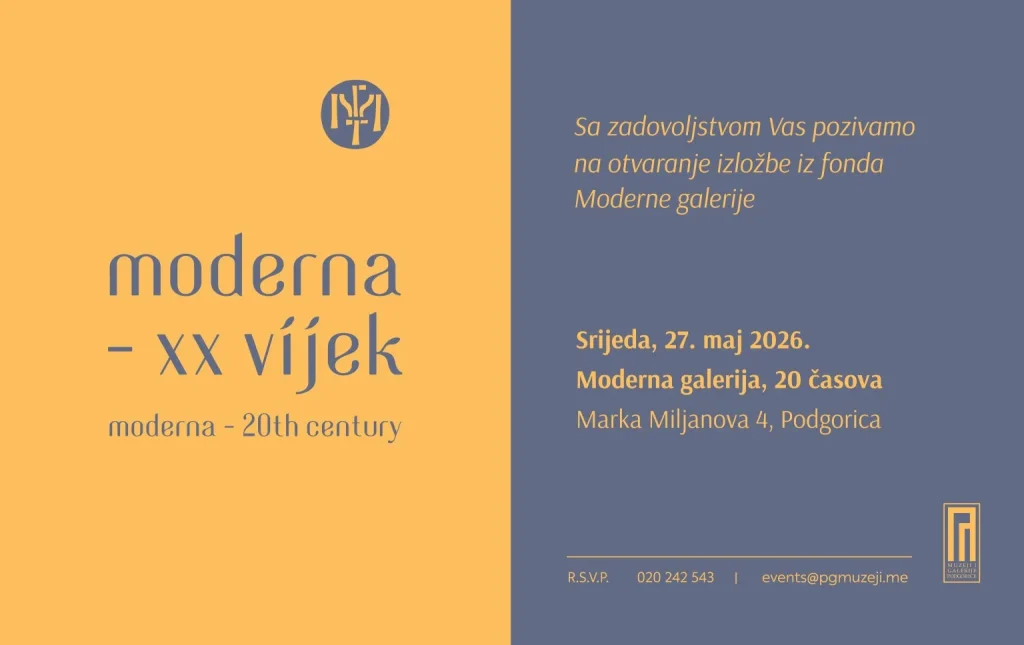
Exhibition „Modern – XX century”🖼️May 27th 2026-May 1st 2027🎨Modern Gallery🎨🏛️🖼️
📍 Moderna galerija
🕐 20:00h

🎧Audiobooks are now available to members of the "Radosav Ljumović" National Library📚 Membership in 2026 is free💳🆓📚🎧✅
📍 JU NB ,,Radosav Ljumović”
🕐 00:00h
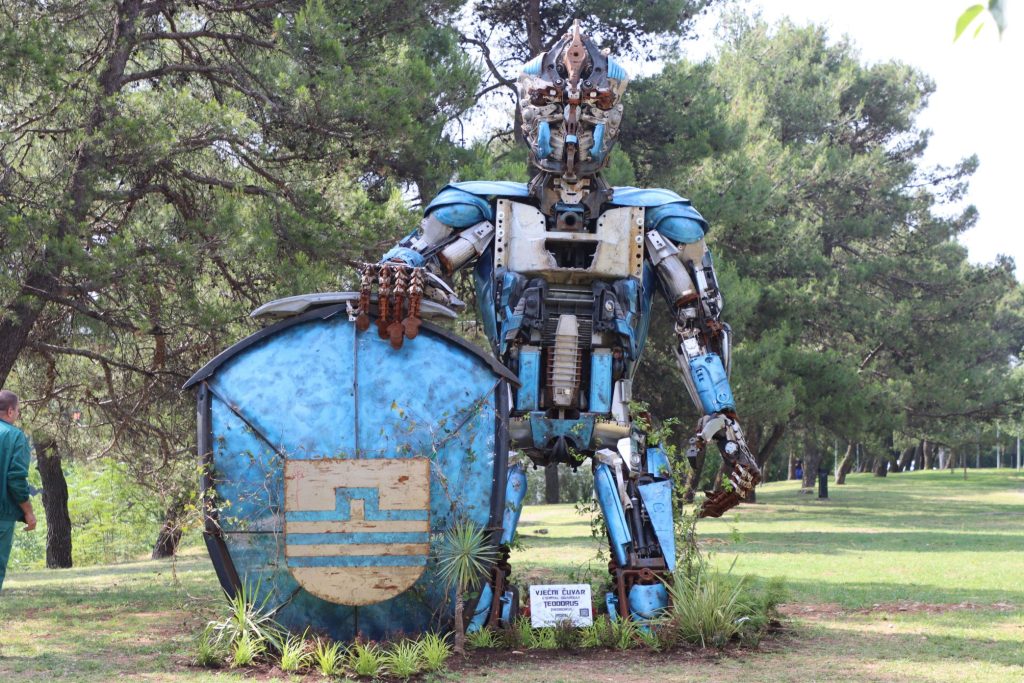
Teodorus - the eternal guardian of the city, placed in the heart of Podgorica 🤖🔵⚪🔵🤖
📍 The banks of the Morača River - The park between the Suspension Bridge & the "Blažo Jovanović" Bridge (near the old Government building)
🕐 10:00h
